Split your events (or other keys) into separate etcd clusters
(Stop Letting Kubernetes Events Kill Your etcd — Here’s the Fix)
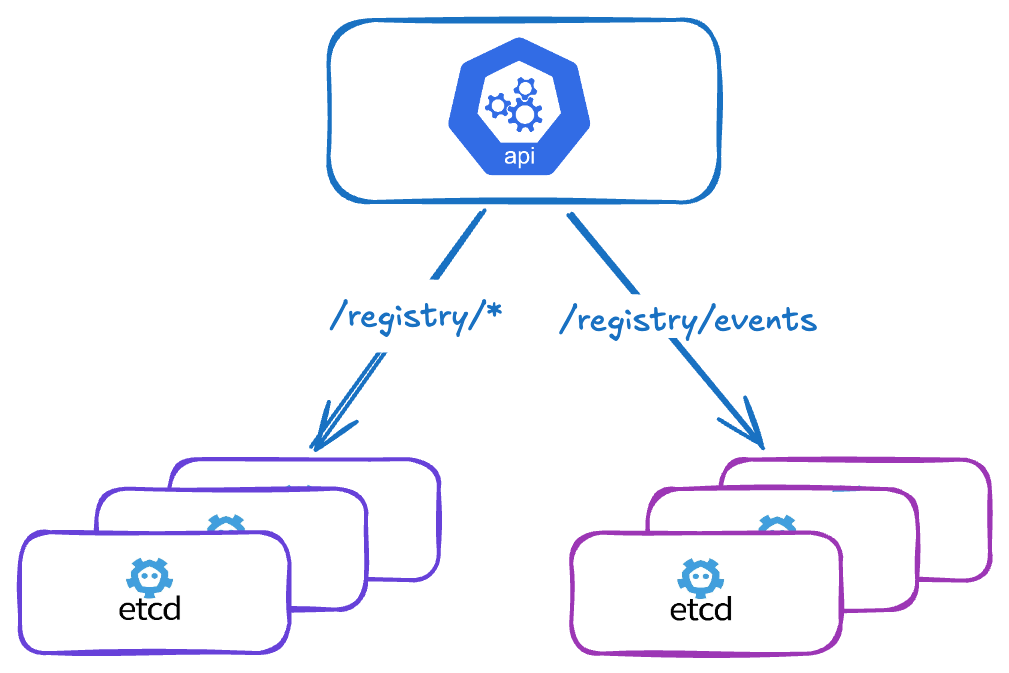
In large Kubernetes clusters, events can quickly become a problem. While they are useful for debugging and observability, they generate a very high volume of writes to etcd, which can severely degrade the performance of the main etcd cluster and therefore impact the entire Kubernetes API.
Problem
In Kubernetes, events are stored in etcd under the prefix /registry/events.
In high-activity environments (many pods, deployments, controllers…), this prefix becomes heavily used:
- Massive and continuous writes
- High data turnover (short TTL by default: 1h)
- Pressure on etcd storage and CPU
- More frequent etcd compaction and defragmentation
Solution: offload certain keys to a dedicated etcd
Kubernetes allows redirecting certain keys to a separate etcd cluster via the kube-apiserver flag:
--etcd-servers-overrides
Format
--etcd-servers-overrides=<prefix>#<server1>,<server2>,<server3>
Servers within the same group are separated by commas (
,). Multiple overrides are also separated by semicolons (;).
kube-apiserver configuration example
# Main etcd
- --etcd-servers=https://10.0.0.11:2379,https://10.0.0.12:2379,https://10.0.0.13:2379
- --etcd-cafile=/etc/kubernetes/pki/etcd/ca.crt
- --etcd-certfile=/etc/kubernetes/pki/apiserver-etcd-client.crt
- --etcd-keyfile=/etc/kubernetes/pki/apiserver-etcd-client.key

# Offloading events to a dedicated etcd cluster
- --etcd-servers-overrides=/events#https://10.0.1.20:2379,https://10.0.1.21:2379,https://10.0.1.22:2379
Benefits
- Reduced load on the main etcd
- Better overall API server performance
- Isolation of highly volatile data
- Independent scalability of both clusters
- Independent compaction/defragmentation cycles
Limitations and constraints
Shared authentication
The kube-apiserver uses the same TLS client certificates (etcd-certfile / etcd-keyfile) for all etcd clusters, including overrides. It is not possible to specify different certificates per cluster.
In practice: both etcd clusters must be signed by the same CA and accept the same kube-apiserver client certificate.
Availability
If the events-dedicated etcd becomes unavailable:
- The kube-apiserver keeps attempting to write/read events
- Timeouts and retries impact overall performance
- The main etcd remains operational, but the API server is degraded
Best practices
- Deploy the events etcd in high availability (minimum 3 nodes)
- Monitor both etcd clusters separately
- Tune event retention:
--event-ttl=1h(default value) - Limit overrides to highly volatile keys (events, leases…)
- Do not offload critical keys such as
/registry/podsor/registry/secrets
Other candidate keys
Beyond events, other prefixes can be offloaded depending on the use case:
| Prefix | Description |
|---|---|
/events | Kubernetes events (most common case) |
/leases | Leader election and node heartbeats |
/pods | Not recommended — critical key |
Conclusion
Offloading /registry/events to a separate etcd cluster is an effective optimization for large Kubernetes clusters where events become a real bottleneck.
This must be set up carefully: the dedicated etcd must be highly available, and both clusters must share the same PKI.
Primarily intended for very high-throughput production environments.